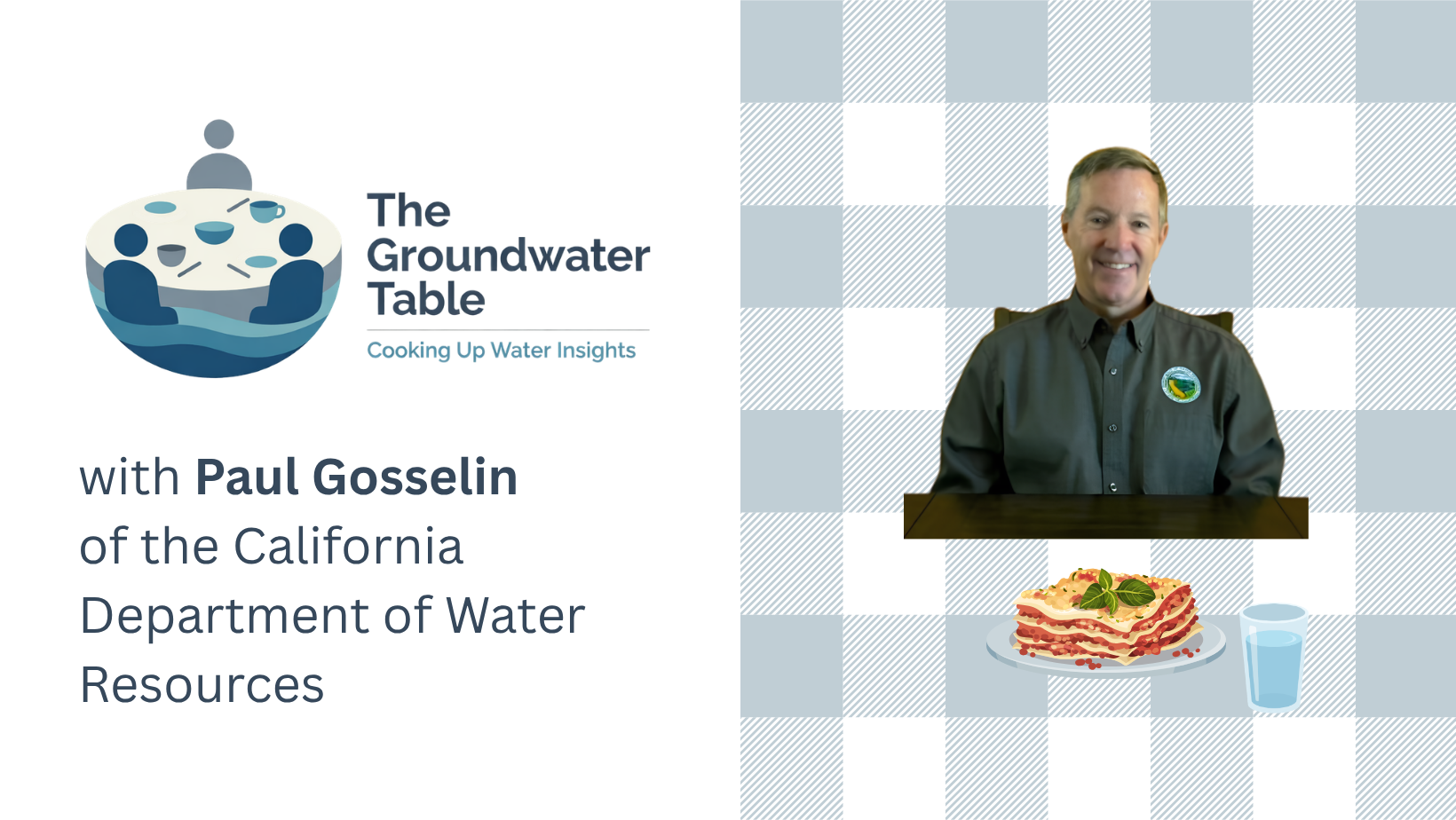
As deputy director for sustainable water management at the Department of Water Resources, Paul Gosselin has been overseeing implementation and enforcement of California’s historic Sustainable Groundwater Management Act, or SGMA, for five years. Paul and the Department of Water Resources have emphasized the importance of groundwater demand management in their reviews of groundwater sustainability plans, alongside supply-side solutions such as aquifer recharge. Given that emphasis, we thought Paul would make the perfect subject to help us kick off the Groundwater Demand Management Network’s new blog series, The Groundwater Table. The following Q&A has been edited for length and clarity.
How do you define demand management, and why has it become a focus for DWR?
Demand management can take many forms, but at the end of the day, it’s about limiting groundwater extraction. You can do that in a variety of ways: changing crops, changing land use, and changing irrigation practices. Allocations drive what those ultimate changes will be.
Early on, we weren’t surprised that many groundwater sustainability plans initially emphasized supply augmentation through recharge and other programs. But a lot of basins have some large holes to climb out of, and there’s no way they can do it through supply augmentation alone. Demand Management must come into play, and it takes some time and effort to get there.
How should GSAs get started?
This is very locally driven. Start talking with people, start acknowledging what has to happen, and start collaborating with your local landowners and community groups and others. The easiest “no regrets” step is to start the dialogue early on and bring people in, because it’s going to be a very controversial and touchy subject.
Every basin should be transparent about its sustainable yield and translate what an individual grower can extract without causing undesirable results. A lot of growers are pretty wise about hydrology, and a lot of demand management can be done through choices individual growers make on their parcel. They are the water manager on that land, and we need to start treating them as such.
Do you think there are preconceptions or misconceptions about demand management?
Absolutely. The first is that it’s going to be brutally difficult. You’re going to be challenged in public. It’s going to result in lawsuits. But start engaging people early on and have open, frank conversations. If people feel they have some ability to help find solutions, there’s ways to get there.
There’s a misconception that this is all targeting agriculture, but it’s not. Agriculture does use most of the water in most basins, and will have to be part of the solution. The implementation of SGMA will be the first time that many growers faced limits on groundwater extraction. The intention is to ensure demand management fits within the basin’s overall approach to achieving sustainability, which will ultimately benefit agriculture in the long run.
How can data, information, and accounting systems help GSAs know if they’re on the right path?
We’ve seen systems in different basins that have increased transparency and enhanced trust. You’re dealing with people’s livelihoods when you start minimizing their water and changing what they were expected to do with that land. This requires sensitivity and acknowledgment. There are big questions related to demand management, such as “How will allocations be set and managed?” And, before that question can be answered, basins need to establish commonly trusted data.
Let’s talk a little bit about land repurposing. The state’s been recently playing a major role in publicizing and funding different types of programs. Are there lessons learned already?
I think a fear we all have is that with less pumping, the fallowing of agricultural lands would be scattered. But California’s Multibenefit Land Repurposing Program (MLRP) brings together a coalition of people within the basin to look at the long-term strategies for the betterment of the basin. That builds on SGMA’s foundation of local control and can take a number of different angles.
Like a city’s general plan, a community chooses its values for the future. Beyond, focusing on allocations, there needs to be a broader long-term strategy about what does that mean for the basin, for the communities and the economic base. And that’s where MLRP will come in.
The state’s LandFlex program was very successful in helping individual growers transition away from hardened water supplies. By participating, we helped them offset the cost of removing trees and vines. They agreed not to pump for a year during the drought. I’ve talked to a small walnut grower who said it actually kept their 300-acre family farm in business. These are the kinds of demand reduction we’re thinking of. Having options is going to be really important so basins are not just looking at a single demand management strategy.
MLRP has been allocated almost $300 million is state funding, and yet it’s really nothing compared to the need. How do we scale?
We need a much larger effort toward land repurposing beyond MLRP.This is a local community effort that really hinges upon land use decisions, but I think the state should play a much larger role on this in the future.
The San Joaquin Valley Collaborative Action Program (CAP) estimated that nearly $15 billion is needed, which some people scoff at. I don’t think it’s unreasonable. We’ve had short-term, fast-moving natural disasters that ended up costing around that same amount.
This is more like a slow-moving disaster, which is challenging. How do we get folks to notice?
Right, and slow-moving disasters are more insidious. Because it’s slow-moving, it’s incumbent upon us to tackle it before it really locks in. Avoiding conversations about demand management and acknowledging a basin’s limitations is feeding into the looming disaster. Those hard conversations should happen as soon as possible.
Given the amount of time we have to comply with SGMA, do you think we’ll be able to get to groundwater sustainability?
Yes, I’m still absolutely confident we’re going to get there. I hope we’ll look back in 10 years and see that we were in the early days of implementation.
[There are] incubators and collaborations going on that are starting to identify with specificity what needs to be done, and putting dollars associated with that is going to help identify sources in the future. Good bridges are being built, and good partnerships are forming. We’re starting to see some ag-urban district coordination on supply augmentation. We can help set up a structure for locals to identify the pathway they want to take and the projects they need, and then we and others can come in and support them.
The other effort that’s going to be really important for scaling up is the new California Water Plan under SB 72 and its goal of identifying 9 million acre-feet of new water supply by 2040. I think having specific projects on the table, driven by local agencies, and seeing what develops into the California Water Plan will make it easier to build support and momentum.
One final fun question for this Cooking Up Water Insights blog series: What is your favorite family recipe or dish and why is it special to you?
I’m second-generation Italian, and my mother taught me how to make homemade lasagna. There’s no written recipe. You basically start with six cups of flour, six eggs, and then you just look at how much or how little salt and water to add. You really work the noodles, make sure they’re pretty thin, and make sure you dry them out before you place them. So, every fall around November, I’ll pick a day when there’s a good football game on, and I’ll spend six-plus hours making a couple of pans of lasagna. It freezes well, so I’ll make some for the holidays and some small pans to give away.